|
|
ARBUCKLES' ILLUSTRATED ATLAS
of
Fifty Principal Nations of the World
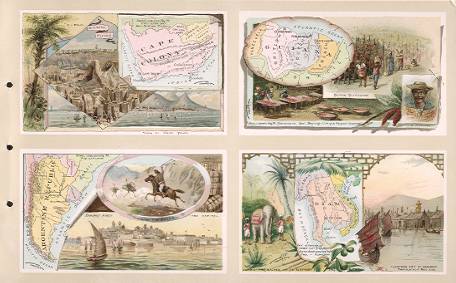
(Actual Size: 6-7/8" x 11-1/8" - shown approx. 1/2 scale)
CLICK on any map to see the
corresponding card as it was originally issued. |
 Cape Colony, Guiana, Argentine Republic, Siam Cape Colony, Guiana, Argentine Republic, Siam
(facing page)
|
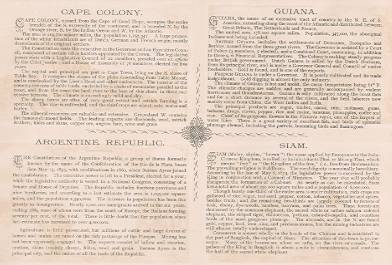
CAPE COLONY.
CAPE COLONY, named from the Cape of Good
Hope, occupies the entire breadth of the
S. extremity of the continent, and is
bounded N. by the Orange river, S. by the
Indian Ocean and W. by the Atlantic.
The area
is 219,700 square miles, the population
1,252,347. A large proportion of the
white inhabitants are of Dutch, German
and French origin, mostly decendants of
the original settlers.
The
Constitution vests the executive in the
Governor and an Executive Council,
composed of certain office holders
appointed by the Crown. The legislative
power rests with a Legislative Council of
22 members, presided over ex officio
by the Chief Justice; and a House of
Assembly of 76 members, elected for five
years.
The
capital and principal sea port is Cape
Town, lying on the S. shore of Table Bay.
It occupies the slopes of the plain
descending from Table Mount, and is
overlooked by the Lion's Head and other
eminences. The interior of the country
consists of table lands, encircled by a
chain of mountains parallel to the coast
and from the coast the land rises to the
base of this chain in three successive
terraces. The climate is exceedingly mild
and dry.
The sheep
farms are often of very great extent and
ostrich farming is a specialty. The vine
is cultivated, and the chief crops are
wheat, oats, maize and barley.
The
mineral resources are valuable and
extensive. Griqualand W. contains the
famous diamond fields. The leading
exports are diamonds, wool, ostrich
feathers, hides and skins, copper ore,
angora hair, wine and grain.
|
GUIANA.
GUIANA,
the name of an extensive tract of country
in the N. E. of S. America, extending
along the coast of the Atlantic and
distributed between Great Britain, The
Netherlands and France.
The
united area, 178,000 square miles.
Population, 347,000, the aboriginal
Indians not being included.
BRITISH
GUIANA includes the settlements of
Demarara, Essequibo and Berbice, named
from the three great rivers. The Governor
is assisted by a Court of Policy (9
members, 5 elected), and a Combined
Court, containing, in addition to these
9, 6 Financial Representatives. The
Colony is making steady progress under
British government. Dutch Guiana is
called by the Dutch Surinam, from its
principal river, and is under a Governor
General and Council of native
freeholders. Gold is found, and is one of
the exports.
FRENCH
GUIANA is under a Governor. It is poorly
cultivated and its trade insignificant.
Gold digging is almost the only industry.
The
climate of Guiana is hot and moist, the
mean temperature being 81º F. The
climatic changes are sudden and are
generally accompanied by violent
hurricanes and thunderstorms. Guiana is
only cultivated along the coast flats and
for a short distance up several of the
rivers, and the field laborers now mainly
come from China, the West Indies and
India.
The
principal products are sugar, timber,
cacao, rum, molasses, gums, balsams,
drugs, cloves, pepper, rice and maize,
bananas, pineapples, coffee and rice.
Chief of its gorgeous flowers is the Victoria
regia, one of the largest of water
lilies. There is a great variety of
excellent fish, and birds of splendid
plumage abound, including the parrots,
humming birds and flamingoes.
|
|
ARGENTINE REPUBLIC.
THE Constitution of the Argentine
Republic, a group of States formerly
known by the name of the Confederation of
the Rio de la Plata, bears date May 15,
1853, with modifications in 1860, when
Buenos Ayres joined the confederacy. The
executive power is left to a President,
elected for a year; while the legislative
authority is vested in a National
Congress, consisting of a Senate and
House of Deputies. The Republic includes
fourteen provinces and nine territories,
and according to a last estimate the area
is 1,095,000 square miles, and the
population 2,540,000. The increase in
population has been due greatly to
immigration. Nearly 1,000,000 immigrants
arrived in the six years, ending 1889,
most of whom were from the south of
Europe, the Italians forming seventy per
cent. of the total. There is little doubt
that the population since last estimate
has increased to over 4,000,000.
Agriculture is little prosecuted, but
millions of cattle and large droves of
horses and mules are raised on the rich
pasturage of the Pampas. Mining has not
been vigorously engaged in. The exports
consist of tallow and stearine, mutton,
skins (mainly sheep), hides, wool and
grain. Buenos Ayres is the principal
city, and the outlet of all the trade of
the Republic.
|
SIAM.
SIAM
(Malay, sâyâm, "brown") the
name applied by Europeans to the
Indo-Chinese Kingdom, is called by its
inhabitants Thai, or Muang-Thai, which
means "free" or "the
Kingdom of the free," i.e.,
free from Brahmanism. The prevailing
religion is Buddhism. The royal dignity
is nominally hereditary. According to the
law of May 8, 1874, the legislative power
is exercised by the King in conjunction
with a Council of Ministers. The year
1891 will probably inaugurate the
formation of a Cabinet. As nearly as can
be calculated, Siam has a total area of
about 250,000 square miles and a
population of 6,000,000.
Though
barely one-third of the entire area is
under cultivation, rich crops are
gathered of rice, sugar, teel-seed,
pepper, cotton, tobacco, vegetables and
spices, besides fruits; and the remaining
two-thirds are largely covered by forests
of teak, ebony, dye-woods, bamboo,
banyans, and palm trees. These forests
are denizened by the common elephant, the
sacred white or rather salmon colored
elephant, the striped tiger, rhinoceros,
python, cobra-di-capello, and countless
birds of the most gorgeous plumage. Tin
abounds, and in the N. are found gold,
copper, lead, iron, zinc, and precious
stones, but the mining industries are
still almost totally undeveloped.
Commerce
is almost wholly in the hands of the
Chinese and is restricted to the port of
Bangkok, the capital of Siam. The
situation of this town is picturesque.
Many of the houses are afloat on rafts,
on the river or canals. The palace of the
King in Bangkok is about a mile in
circumference, and contains the hall of
the sacred white elephant.
|
|