| Reverse - Text |
Left section:
GRIND
YOUR COFFEE AT HOME
Right section: |
| VERMONT. |
| THE first European to
see Vermont was Champlain, who in
1609 came south from Canada with
a war-party of Hurons on a foray
against the Iroquois. The first
colony established by the French
at Fort St. Anne, in 1665, was
opposed by an outpost at Chimney
Point, built by the Dutch from
Albany. After the conquest of
Canada in 1760, the French
settlements along Lake Champlain
disappeared. After the district
suffered separation from
Massachusetts, it was claimed by
both New Hampshire and New York.
A tide of colonists poured in
with titles issued by New York,
endeavoring to oust the New
Hampshire grantees. The latter,
under the direction of Ethan
Allen and Seth Warner, formed
themselves into the "Green
Mountain Boys," and fought
the intruders stubbornly for many
years. In 1775 Ethan Allen and
eighty-three Green Mountain boys
surprised the British garrison at
Fort Ticonderoga, and compelled
its surrender. In 1777 General
Stark and 1,600 militia
vanquished the British army near
Bennington. A magnificent
monument now marks the spot. In
the war of 1812 Burlington was
fortified and garrisoned, and
2,500 Vermont volunteers joined
in the fight against Sir George
Prevost at Plattsburgh. The drain
of furnishing inhabitants to the
West has kept Vermont nearly
stationary in population. In 1889
the State Commission found over
200,000 acres of abandoned fields
growing up into woodland. Many
French-Canadians have moved into
the northern counties and factory
towns. |
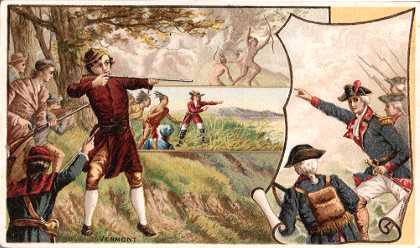
| ILLUSTRATIONS. |
Champlain
Discovering Lake Champlain, 1609;
Green Mountain
Boys; General Stark at the Battle
of Bennington, 1777. |
|