Reverse - Text
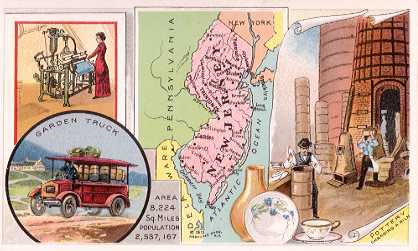
| NEW JERSEY |
New
Jersey, one of the original thirteen
states, is bounded by New York, Atlantic
Ocean, Delaware Bay and Pennsylvania;
gross area, 8,224 sq. miles; land area,
7,514 sq. miles; water area, 710 sq.
miles; capital, Trenton. The principal
river is the Delaware.
The surface
of the State is undulating and hilly in
the northern part and low and sandy in
the southern part. The soil is a sandy
loam admirably adapted to agriculture.
The
principal farm crops are corn, wheat,
hay, and potatoes. The sand plains in the
south raise an abundance of cranberries,
and the peach, apple, pear and berry
crops of New Jersey are of great value.
For its
size, New Jersey is one of the richest
mineral-producing States in the Union.
The principal minerals are magnetic iron,
copper, zinc, lead, plumbago, manganese,
nickel, limestone, slate and trap.
Arbuckles' Coffee is always right; always
dependable; always sixteen ounces to the
pound.
The
manufactures of New Jersey are very
extensive and varied, jewelry, pottery,
leather and hats, being the principal
articles of manufacture. There are
extensive stock yards, grain elevators,
abbatoirs, steel works and sugar
refineries.
The climate
of New Jersey is generally temperate.
Population
in 1910, 1,286,463 males and 1,250,704
females, of whom 1,876,379 were of native
and 660,788 of foreign birth; white,
2,445,894; negro, 89,760; Indian, 168;
Chinese, 1,139; Japanese, 206. Total
population, 2,537,167. |
| This is one of a series of 54 cards. |
|